
BAY HILL AND THE ARNOLD PALMER INVITATIONAL: SOME HISTORICAL NOTES
by Frank Cantrel, Jr.
The PGA Tour will make its annual pilgrimage to Bay Hill Club & Lodge March 2-8 for the third Signature event of the new golf season. Tucked among rolling terrain southwest of Orlando, Florida, Bay Hill occupies a special place in golf history. Known today as the annual home of the Arnold Palmer Invitational, the club is far more than a tournament venue. Its story is one of vision, opportunity, and the profound influence of one of golf’s most beloved figures. From raw land to world-class championship course, Bay Hill’s rise mirrors Arnold Palmer’s own impact on the modern game
Early Beginnings: A Course Takes Shape
Before fairways and greens defined the landscape, the land that would become Bay Hill was part of a large holding owned by Florida citrus magnate Dr. P. Phillips. Unlike surrounding acreage, this tract proved unsuitable for citrus cultivation and remained largely undeveloped. In the late 1950s, businessmen Tom Barnes and Tom Dore recognized the area’s potential as a golf destination and began plans to create a private club there.
Construction started in 1960, and Bay Hill opened for play in 1961. The course was designed by prominent architect Dick Wilson, whose work emphasized strategic bunkering, water hazards, and risk-reward shotmaking. From its earliest days, Bay Hill earned a reputation as a challenging but fair test — one that rewarded thoughtful play rather than brute force.
Arnold Palmer’s Influence
The defining moment in Bay Hill’s history occurred in 1965, when Arnold Palmer visited the club to compete in a charity exhibition. Already a global sports icon and the most popular golfer of his era, Palmer immediately recognized something special in the layout. Its challenge appealed to a man who felt that “[s]uccess in golf depends less on strength of body than upon strength of mind and character.”
After the round, he famously told his wife, Winnie, that he had just played the best golf course in Florida — and that he wanted to own it.
What began as admiration quickly turned into commitment. In 1970, Palmer signed a five-year lease on Bay Hill with an option to purchase. Five years later, he exercised that option, making Bay Hill his winter home and the centerpiece of his growing golf and business interests.
Palmer took an active role in shaping the course’s future. Working closely with architect Ed Seay, he refined holes, enhanced water features, repositioned bunkers, and lengthened the course to keep pace with evolving equipment and athleticism. His goal was clear: preserve Bay Hill’s character while ensuring it remained a rigorous test for the world’s best players.
Palmer served as club president and chairman of the course committee, personally overseeing changes and remaining deeply involved in day-to-day decisions. Bay Hill became an extension of Palmer himself.
A PGA Tour Showcase
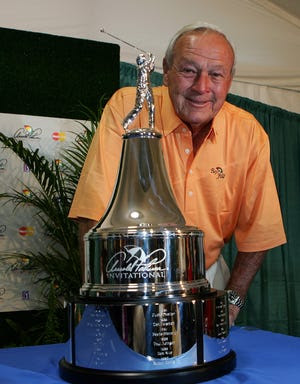
Bay Hill entered the national spotlight in 1979, when Palmer brought a PGA Tour event to the club. The tournament, formerly played at Rio Pinar Country Club, moved to Bay Hill and in 2007 the event was officially renamed in Palmer’s honor. Today, the Arnold Palmer Invitational is considered one of the most prestigious non-major events on the Tour and is designated a Signature Event, attracting elite fields and significant purses. This year, its total purse will be $20 million and the winner will walk away with $4 million.
Bay Hill’s demanding layout has crowned many of golf’s greatest champions, reinforcing its reputation as a true test of excellence. Tiger Woods stands foremost among them, having won the tournament a record eight times, using Bay Hill as a proving ground during his most dominant years.
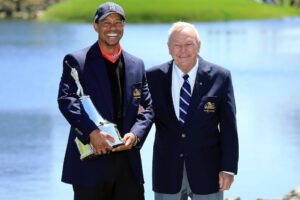
Other notable winners include Arnold Palmer himself, who claimed victory twice, Jack Nicklaus, Sam Snead, Ernie Els, Fred Couples and Payne Stewart. Rory McIlroy won it in 2018 and the world #1-ranked player, Scottie Scheffler, is a two-time winner, with victories in 2022 and 2024. This diversity of champions underscores the course’s balance and strategic design that require precision off the tee, disciplined iron play, and nerve-tested putting under pressure.
A Living Legacy
Arnold Palmer remained closely connected to Bay Hill until his passing in 2016, regularly appearing during tournament week to greet players and fans. His warm and outgoing presence were an integral part of the event.
Today, the eponymous tournament honors the memory of The King and the course’s evolution remains true to Palmer’s original vision. Each March, when the world’s best players walk its fairways, Bay Hill stands as a tribute to championship golf and also to the man whose passion transformed a quiet stretch of Florida land into one of the sport’s most revered stages.