A Founder Before the Founding: Why a Babe Zaharias Amateur Victory Photo Is the Kind of Golf Collectible That Truly Matters
There are golf collectibles, and then there are pieces that feel like they carry the game’s DNA.
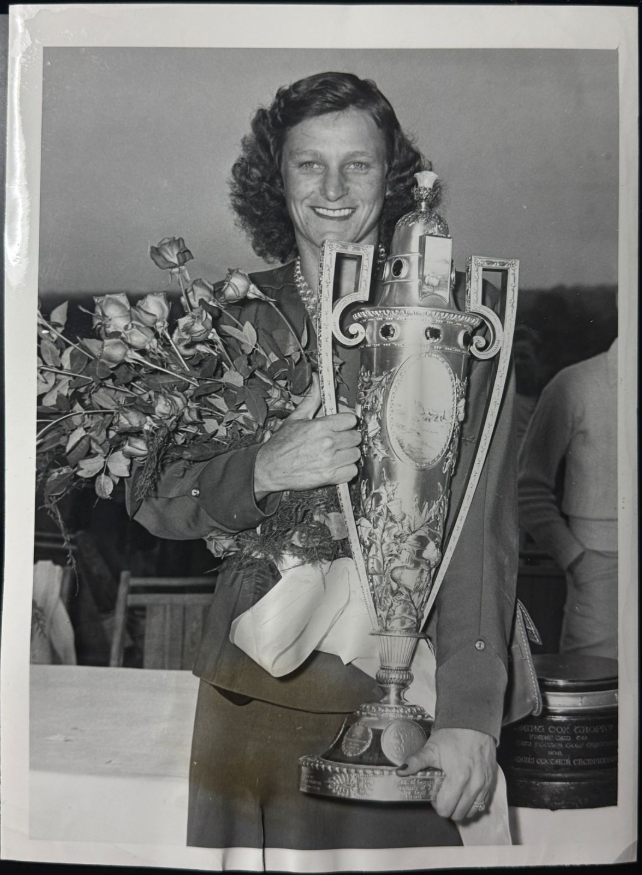
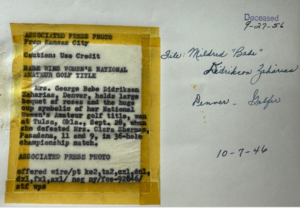
The photo I keep coming back to this week, from GHS President George Petro’s collection, falls squarely into that second category: a period Associated Press image of Babe Didrikson Zaharias after her 1946 U.S. Women’s Amateur victory, smiling with flowers and trophy in hand. On the back, there is the old AP captioning, identification in handwriting, and the sort of newsroom wear that collectors love because it reminds you this item was not made to be precious. It was made to be used, handled, filed, transmitted, and remembered.
That matters.
In a hobby that often leans heavily on signed flags, modern trading cards, logo golf balls, and tournament badges, an original press photo like this has a different kind of gravity. It is not merely decorative. It is documentary. It captures a real championship moment involving one of the most important figures the women’s game has ever known: Babe Didrikson Zaharias, who won the 1946 U.S. Women’s Amateur at Southern Hills by defeating Clara Sherman, 11 and 9.
That victory alone would make the image significant.
But what elevates it from “interesting old photo” to “serious heritage piece” is where Babe stands in the larger story of golf. Four years after that amateur triumph, she became one of the 13 founding members of the LPGA. That gives this photo a direct, meaningful link to this week’s Fortinet Founders Cup at Sharon Heights, an event specifically created to honor the 13 women who built the LPGA.
That is what good collecting often looks like at its best: not just owning an item, but understanding the thread it pulls through history.
And this photo pulls a strong one.
Babe’s 1946 U.S. Women’s Amateur title came at a time when her legend was already growing, but before the LPGA formally existed. In other words, this image captures a founder before the founding. It preserves a championship moment from the era when women’s golf was still fighting for stable footing, mainstream respect, and consistent institutional support. Seen through that lens, the photo is not just about one win. It is about the building of the game.
That is also why original media photos can be so compelling compared to other categories of memorabilia. A signed modern pin flag is fun. A fresh tournament poster can look great framed. But a period wire photo is different. It was part of the information bloodstream of its day. It helped shape how the sporting public saw a champion. In many cases, it may have sat in an editor’s hands or in a newspaper archive long before anyone thought of golf memorabilia as a collecting category in the modern sense.
Your example has exactly the sort of traits that make these pieces stand out. The image itself is strong, with Babe posed proudly behind an enormous trophy and bouquet. The reverse is perhaps even better from a collector’s standpoint: old caption sheet, transmission notations, typed identification, and handwritten naming. Those things do not just support display value. They help tell the object’s life story.
Now, to be clear, no one should slap a precise dollar figure on a piece like this from a single photograph alone. Condition, dimensions, paper type, stampings, originality of the caption attachment, and comparable sales would all matter. But from a heritage standpoint, it checks the right boxes. It depicts a major competitive moment. It features one of the most important athletes in American sports history. And it connects directly to one of this week’s central themes in professional golf: honoring the LPGA’s founders. That is a powerful combination.
It also helps that the championship itself still carries historical weight. The USGA’s record of champions confirms Babe’s 1946 win at Southern Hills, and the association has continued to highlight that period of her career as essential to understanding her place in golf history. In fact, the USGA has even spotlighted artifacts tied to that same championship in its museum storytelling, which says plenty about how important that victory remains.
And that brings us back to the Founders Cup.
A lot of tournament-week content is understandably present-tense. Who is playing well? Who fits the course? Who might win on Sunday? But one of the pleasures of writing the Collectables column is that it lets us slow down and remember that tournaments are not just contests. They are also carriers of memory. The Founders Cup is richer when you can connect it to a real, tangible object from one of the women whose labor and brilliance helped make the LPGA possible in the first place.
That is what this Babe photo does.
It is tangible. It is historic. It is visually striking. It has a strong story on the front and an even better one on the back. And unlike many collectibles that trade mostly on scarcity or autograph appeal, this one earns its importance the old-fashioned way: by mattering.
In the end, that may be the best test of any golf collectible worth owning. Not whether it is flashy. Not whether it is trendy. Not even whether it is expensive.
Does it tell the game’s story?
This one does.