When The King Played Against Himself: Inside Arnold Palmer’s 1964 Hickory Experiment
A Collectible With a Story Worth Telling
This week, as the PGA Tour returns to Bay Hill for the Arnold Palmer Invitational, I’ve been thinking about what made Arnie so different. Not just the charges or the charisma, but his willingness to meet golf fans exactly where they lived. He didn’t just play the game. He explained it, tested it and invited everyone along for the ride.
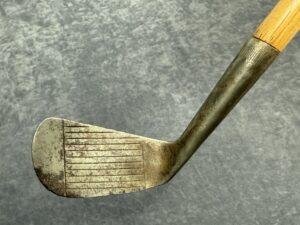
Which brings me to an interesting piece of Palmer history, and a club that sits in Golf Heritage Society President George Petro’s collection: a hickory-shafted iron that Arnold Palmer actually used for a 1964 Popular Mechanics article titled “Arnold Palmer Plays Arnold Palmer.”
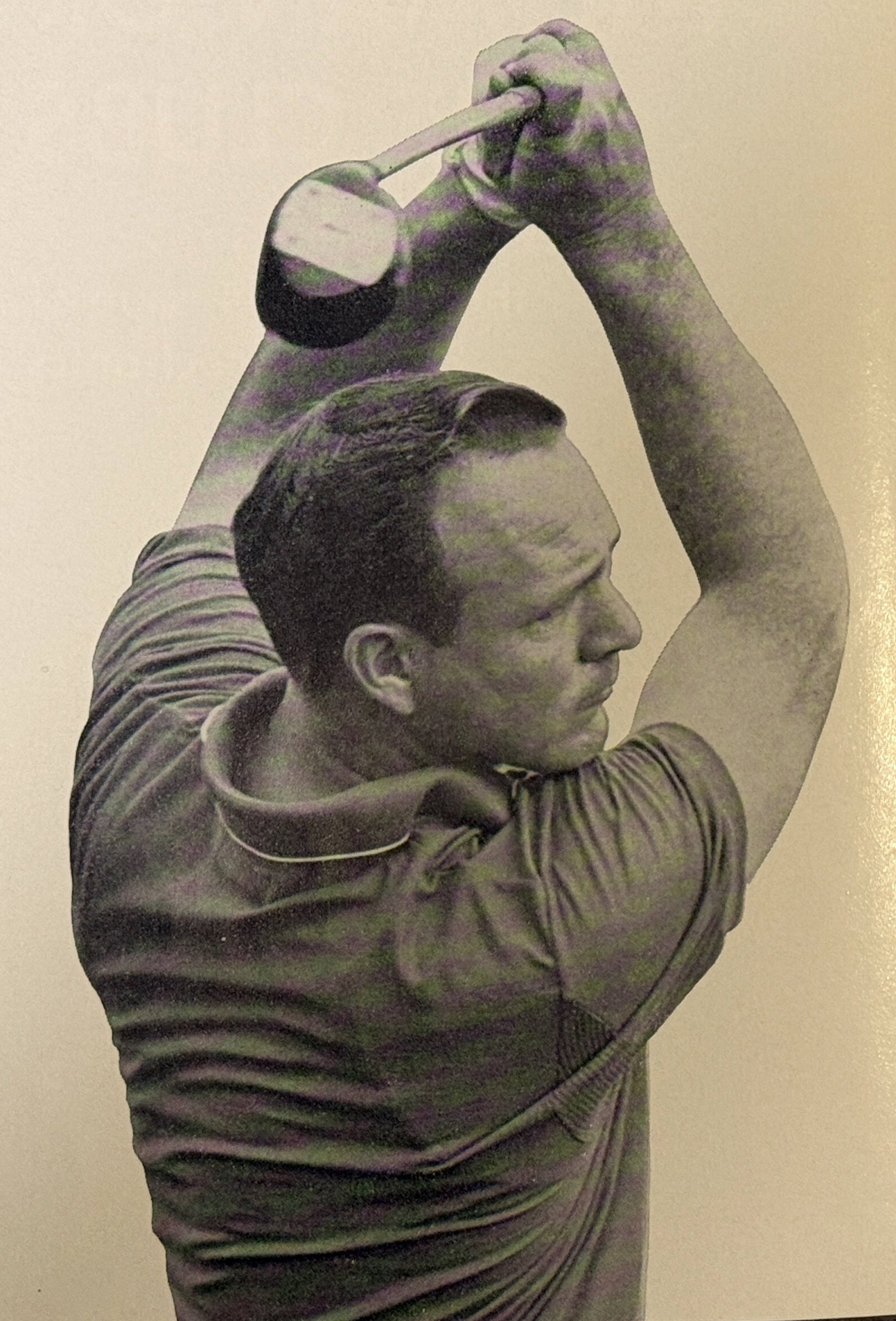
The premise was straightforward and brilliant. Palmer would play a full round against himself, alternating between his modern steel-shafted clubs and a set of hickories like the ones used 30 years earlier. Not as a stunt, but as a real test. Popular Mechanics treated it like an engineering experiment, complete with shot diagrams and hole-by-hole breakdowns. And Palmer, being Palmer, took it seriously.
The Experiment That Wasn’t Really an Experiment
Palmer opened the piece with the kind of honesty that made him Arnold Palmer. He expected the hickories to feel like flying an antique plane after years in a jet. But the gap wasn’t cartoonish. He could still play. He could still score. The difference showed up somewhere more subtle and more important: he couldn’t predict the ball.
That’s the heart of the whole article. Golf confidence isn’t built on feel or vibes. It’s built on repeatability. And hickory shafts, with their natural torque and inconsistency, introduced just enough variability to make Palmer second-guess himself on each hit.
He described it perfectly. The hickories could twist through impact, adding another moving piece he had to control. It wasn’t that he couldn’t hit good shots. It’s that he couldn’t trust them. And for a player like Palmer, whose entire game was built on aggressive, go-for-it instincts, that lack of trust changed everything.
What Modern Really Meant
One of the best insights in the piece is something most golfers today take completely for granted: matched sets. Palmer kept coming back to the idea that his modern clubs let him “swing your swing,” while the hickories required constant mid-round adjustments.
Older sets weren’t truly matched the way we think of matching today. Each club had its own personality, its own quirks. You didn’t just learn your distances. You learned each club individually, like getting to know 14 different people.
The real innovation wasn’t just steel replacing hickory. It was standardization. It was the ability to stand over a 7-iron and know, with confidence, exactly what it would do if you made your normal swing.
The Humble Conclusion
At the end of the round, Palmer admitted the obvious. “Well, what did we prove? My answer is, ‘Nothing.’” Modern equipment was better. Everyone already knew that. But he conveyed it without arrogance, and that’s why the piece still works 60 years later.
His real point was for the average golfer. If a player with Palmer’s talent and practice regimen struggled with the unpredictability of hickory, what chance did a weekend player have? “For the average golfer,” he wrote, “the hickory clubs offer too much chance for error.”
It’s a conversation we’re still having today, just with different technology. Forgiveness. Fitting. Launch monitors. The tools change, but the principle stays the same: better equipment makes the game more playable for more people.
Why This Club Matters
George Petro’s hickory iron isn’t just a collectible. It’s a piece of golf journalism history, a reminder of when Popular Mechanics treated golf like engineering and Palmer treated readers like they deserved real answers.
This week at Bay Hill, players will use drivers that would seem like science fiction to 1964 Arnold Palmer. But the spirit of that Popular Mechanics experiment, the idea that golf is always evolving and always worth examining honestly, that’s pure Arnie.
As Palmer himself concluded: “The difference was not that great, but I’m glad I was born 30 years too late.”
So am I, Arnold. So am I.
PGA of America Golf Professional Brendon Elliott is an award-winning coach and accomplished golf writer whose work has captivated readers across multiple platforms. His insightful column “The Starter” can be found on R.org, while his compelling stories grace the pages of Athlon Sports. To keep up with his latest insights and analysis, subscribe to his newsletter or explore his full portfolio on MuckRack. Elliott now brings his expertise and passion for the game to the Golf Heritage Society as our new lead writer.
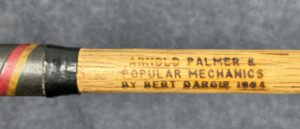
The shaft stamp just below the grip of one of Arnie’s hickory clubs. Bert Dargie made new hickory shafts and inserted them into the individual vintage clubheads of the tested woods and irons.