
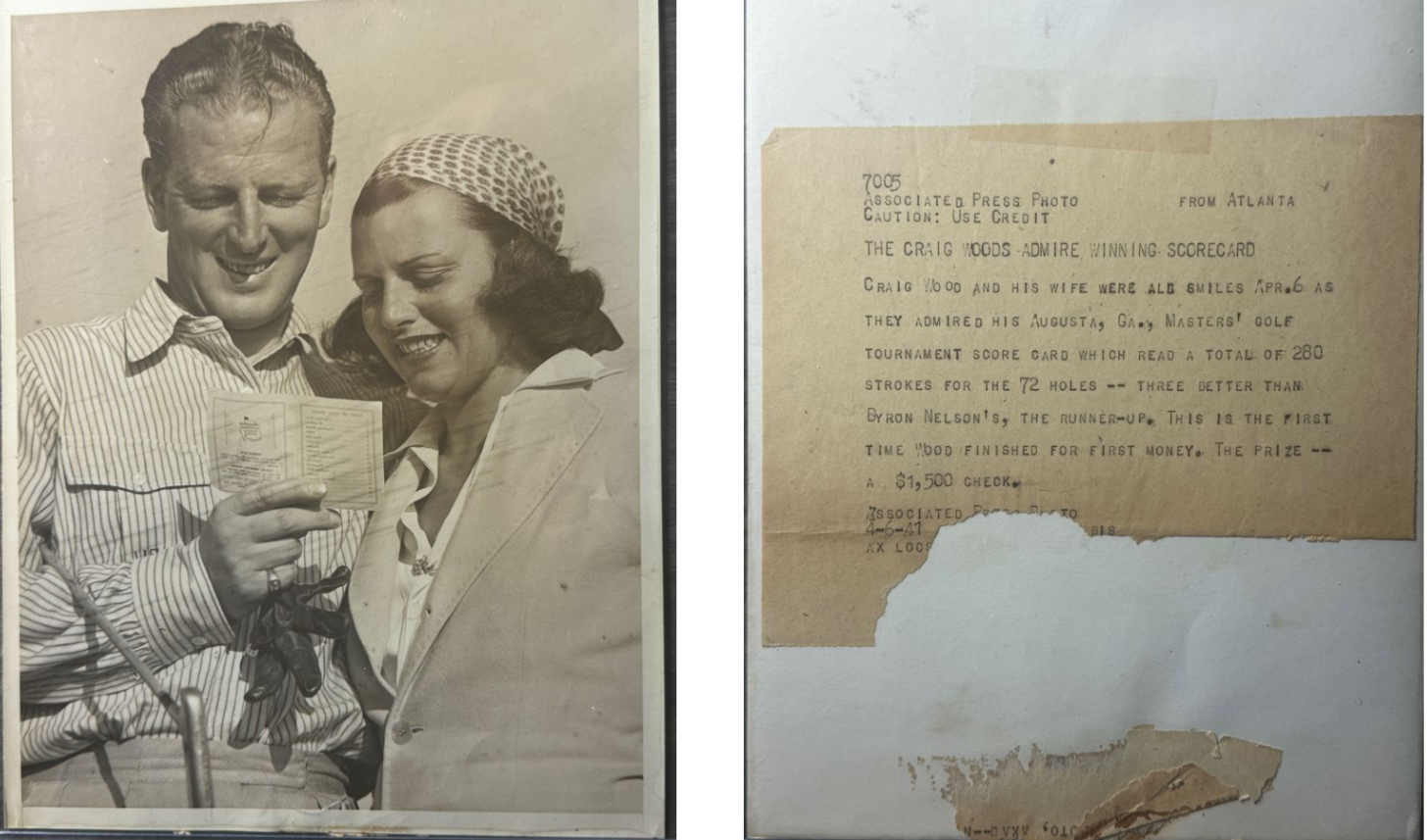
Craig Wood’s Masters Story, In Silver, Gold and Paper
Some collectibles impress you at first glance. Others take hold because the longer you study them, the more deeply they pull you into the story.
This Craig Wood grouping does both.
In the hands of Golf Heritage Society President George Petro are a 1941 Masters winner’s gold medal, a 1935 runner-up silver medal, a period photo of Wood and his wife admiring his winning scorecard, the Associated Press caption mounted on the back of that image and another vintage photo that appears to show Wood alongside Gene Sarazen in one of Augusta’s earliest and most famous moments. Put together, the grouping does more than preserve a champion’s memory. It captures the full arc of Craig Wood at the Masters, from heartbreak to triumph, from near miss to breakthrough. Wood made 25 Masters starts from 1934 through 1961, finished runner-up twice and finally won in 1941.
That alone would make this an important collection. What elevates it is the way the pieces speak to one another. The silver medal points to the ache of 1935. The gold medal points to the release of 1941. The AP photo of Wood and his wife gives that triumph a human face. And thanks to Petro’s collector-level explanation of Augusta’s award history, the medals themselves become even more interesting than they first appear.
The Photo That Dates To 1935
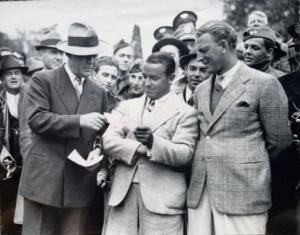
Let’s start with the black-and-white image from that 1935 Masters showing Grantland Rice, Gene Sarazen and Craig Wood. Rice is seen presenting checks to Sarazen and Wood after Sarazen won the 36-hole playoff.
In 1934, Wood finished runner-up to Horton Smith in the inaugural Masters. In 1935, he suffered one of golf’s great heartbreaks when Sarazen holed his fairway 4-wood for a double eagle on the par-5 15th, the shot forever remembered as the one that changed Masters history. Sarazen then defeated Wood in the playoff. This photo is a visual marker of one of the most significant scenes in early Augusta lore.
The Silver Medal And What It Really Represents
For years, many collectors and fans have had only a partial understanding of early Masters awards. Petro’s note helps clear that up in a way only a seasoned specialist really can.
As he explained, there were no medals or trophies handed out in the earliest Masters years. Augusta, still financially strained in the 1930s, was focused first on paying prize money. Petro notes that the club later developed a pattern of issuing newer awards retrospectively. The first physical winner’s award, he says, was a wooden plaque with a silver sheet and gold bars naming the winner and score. Those plaques were awarded beginning with the 1942 champion and retrospectively to earlier winners back to 1934. Later, in 1960, Augusta replaced those with the bas-relief clubhouse plaques, and in 1993, it moved to the current 3D silver clubhouse trophy for champions.
That collector knowledge changes how we should view Craig Wood’s 1935 runner-up silver medal. The Masters’ official awards page says the runner-up silver medallion dates to 1951. Petro supplies the key context, namely that in 1951 Augusta awarded gold and silver medals to that year’s winner and runner-up and also issued them retrospectively to prior Masters champions and runner-ups. In other words, Wood’s silver medal is not evidence that such a medal was placed in his hands in April 1935. It is evidence that Augusta later chose to honor that finish in tangible form, and to do so in a way that reached back across its own history.
That does not make the medal less important. Quite the opposite. It makes it more nuanced, and for serious collectors, more compelling. The silver medal is tied to Wood’s most painful Masters memory, the one that slipped away when Sarazen’s double eagle turned inevitability into drama. It is a retrospective award, yes, but it still commemorates one of the defining runner-up finishes in the tournament’s history.
The Gold Medal And The Breakthrough Of 1941
If the silver medal carries the sting, the gold medal carries the answer.
Craig Wood finally won the Masters in 1941 at 280, eight under par, finishing three shots ahead of Byron Nelson. He also became the tournament’s first wire-to-wire champion. That victory mattered well beyond one week at Augusta. It reshaped the way Wood was remembered. Instead of being known chiefly as the man on the wrong side of Sarazen’s miracle in 1935, he now stood as a Masters champion, and later that same year, he added the U.S. Open to complete a remarkable season.
Petro’s explanation adds another layer here, too. Because Augusta did not begin awarding these gold and silver medals until 1951, Wood’s 1941 winner’s medal, though dated to his championship year, belongs to that later retrospective award tradition. That is an important distinction for historians and collectors alike. It reminds us that Augusta’s objects do not always align with the exact moment of victory, even when the accomplishment they honor is unquestioned.
Petro also points out something advanced collectors immediately notice: style. He says Masters medals dated from 1934 into the mid-1970s shared one design style, and that a design change came between 1976 and 1978 with the addition of the Founders Circle drive in front of the clubhouse. That sort of detail is not trivia. It is an authentication language. It helps distinguish earlier-style medals from later ones and helps experienced collectors identify whether a medal is likely an original first-issued example from Augusta’s retrospective 1951 run or a later duplicate.
Why Duplicates Matter
This is where collector knowledge becomes especially valuable.
Petro notes that over the years, some past Masters winners requested duplicate medals, whether because an original was lost, because a family wanted another example, or because an original had been donated elsewhere. He cites Gene Sarazen as one such case, explaining that Sarazen donated his original 1935 medal to the USGA Museum and later requested a duplicate from Augusta. Petro adds that most duplicates were produced after 1980 and therefore tend to appear in the newer medal style, which generally gives them less value than an earlier-style example. To a casual eye, that might seem like a small point. To a serious collector, it is one of the first things that matters.
That is one reason this Craig Wood grouping resonates so strongly. These are not just attractive Augusta items mounted for display. They reward close looking. They invite questions about when an award was instituted, when it was back-issued, how style changed and why provenance matters. The objects are beautiful, but the education inside them is what makes them truly rich.
The Photograph That Humanizes The Win
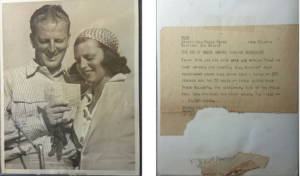
Then there is the photograph of Wood and his wife, smiling over the winning scorecard.
Associated Press’ historical Masters photo roundup includes a 1941 image of Craig Wood and his wife looking over his scorecard after the victory, and that lines up neatly with the tattered caption attached to the back of the example in this grouping. The caption text notes a 72-hole total of 280, three strokes better than Byron Nelson and a first-place check for $1,500. Those details match the official result and transform the photograph from a pleasant vintage image into something more documentary in nature.
For me, that is what completes the set. The medals tell us how Augusta chose to remember Craig Wood. The photo tells us what that breakthrough must have felt like. After all the frustration, all the close calls and all the weight of 1935, there he is with his wife, smiling over the proof.
Why This Grouping Matters
The best golf collectibles do not just preserve hardware; they also preserve the history of the game. They preserve narrative.
That is exactly what George Petro’s Craig Wood grouping does. It starts with the wound of 1935, captured in that photo with Sarazen and Grantland Rice. It moves through Augusta’s unusual and fascinating retrospective award history. It lands at Wood’s 1941 victory, the week he finally claimed the Masters and did so from start to finish. And because Petro took the time to explain the backstory of Masters medals, plaques and duplicates, the collection becomes more than visually impressive. It becomes instructive.
That is the beauty of great golf memorabilia. The object is only the beginning. The real treasure is the story you can unlock from it.