
CELEBRATING THE 40TH ANNIVERSARY OF NICKLAUS’ 1986 MASTERS WIN
The 90th playing of the Masters will take place from April 9–12, 2026 at Augusta National Golf Club. First held in 1934 as the Augusta National Invitation Tournament, this “tradition unlike any other” has offered countless memorable moments and unforgettable finishes.
For many golf historians and journalists, one stands out. Forty years on, for many the 1986 Masters — and the Golden Bear’s golden Sunday remains “the greatest golf story ever told.” Herbert Warren Wind, widely considered the “godfather of American golf literature” for his elegant, authoritative style, wrote in The New Yorker that Nicklaus’ Masters win in 1986 was “nothing less than the most important accomplishment in golf since Bobby Jones’ Grand Slam in 1930.”
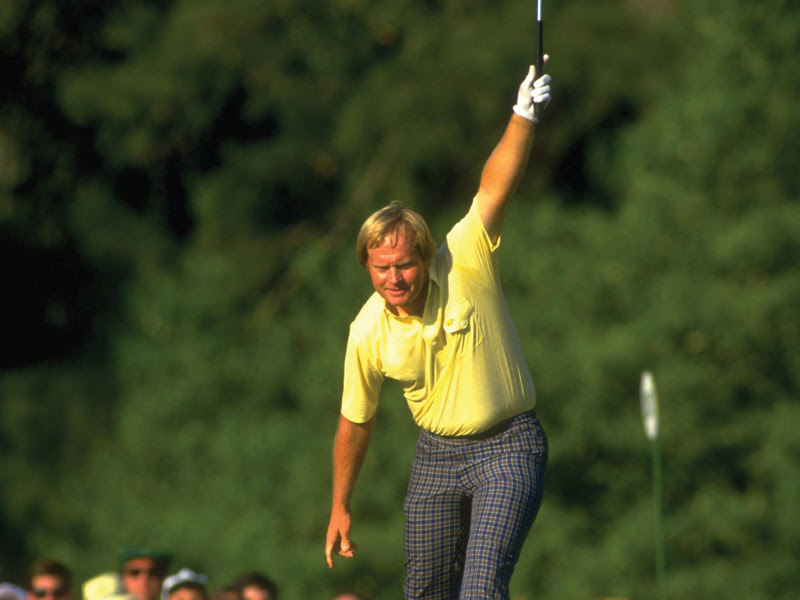
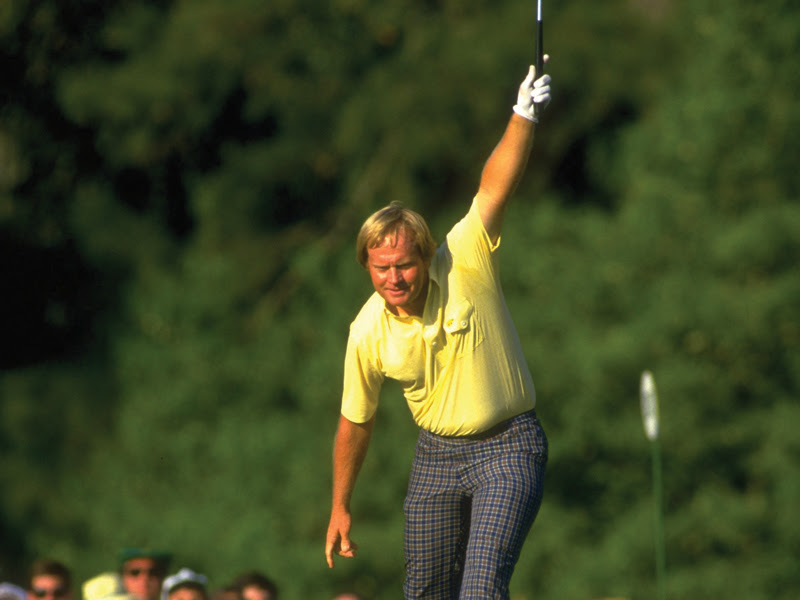
There is a moment lodged permanently in the memory of anyone who watched it unfold on the afternoon of April 13, 1986. A 46-year-old man with silver hair and a slightly thickened midsection — a man the golf press had spent the better part of two years eulogizing as a spent force — stood on the 17th green at Augusta National and pumped his putter skyward as a putt dropped for birdie. The roar that rose from those Georgia pines was more than applause. It was something closer to collective disbelief resolving, in real time, into euphoria. Jack Nicklaus was winning the Masters. Again. For the sixth time.
Forty years have passed since that magical Sunday. The birch trees have grown taller, the azaleas have bloomed and faded four decades over, and the game itself has been remade several times by technology, athleticism, and money. Yet the 1986 Masters endures not merely as a tournament result but as a kind of permanent argument — about age, about greatness, about what golf at its highest pitch is capable of producing. It remains, by almost any measure, the most dramatic 18 holes — and in particular the final round — ever played in a major championship.
The Bear in Winter
To appreciate what happened that April Sunday, consider the depth of the skepticism that preceded it. By then, Nicklaus had won 17 professional major championships and had dominated the game through the 1960s and 1970s with a combination of prodigious length, an unrivaled short game under pressure, and a strategic intelligence that made Augusta National’s premium on placement feel as though it had been designed specifically for his mind. His last major had come in 1980, at the U.S. Open and PGA Championship — a remarkable double. But six years later, he had missed cuts and was ranked 160th on the PGA Tour money list in 1985.
A column in the April 6 edition of the Atlanta Journal-Constitution, handicap
Nicklaus reportedly read the column at breakfast, folded it neatly, and handed it to his son Jackie, who would caddie for him that week. Talk about lighting a fire! Nicklaus later admitted that “[t]o tell you the truth, I kind of agreed…but it helped get me going.” As some of his peers later acknowledged, it’s never wise to “poke the Bear.”
He arrived at Augusta with a new 46-inch MacGregor Response ZT putter — an oversized implement that raised eyebrows in the locker room — and a quiet, gathered resolve that those who knew him well recognized as dangerous. Through the first three rounds he played competently without threatening. After shooting a 69 on Saturday, he stood four shots off the Greg Norman’s lead and was tied for ninth at 2-under. For Sunday’s final round, he was close enough to matter but distant enough that the leaders barely considered him.
Amen Corner and the Awakening
Sunday’s back nine at Augusta in 1986 is, by reasonable consensus, the greatest nine holes ever played in major championship history. Nicklaus accomplished what everyone thought was impossible. What followed over the next two hours was a performance so startling, so violently contrary to expectation, that network producers scrambled to redirect cameras from the groups ahead.
He birdied the 9th. He followed that with successive birdies at the 10th and 11th holes. Tremendous roars from hopeful patrons rang through the pines. At the par-5 13th, he reached in two and two-putted for birdie. At the next par-5, the 15th — where Nicklaus had made so many pivotal decisions over the years — he hit his second shot to within 12 feet and holed the putt. Ben Wright, in witnessing Nicklaus’ back nine charge: “There’s life in the Old Bear yet.” At 15, Wright exclaimed: “Oh, yes, sir! The battle is joined!” His eagle at 15 produced a clamor that echoed across the course.
The patrons, swelling now and fully alive to what was happening as he ascended the leaderboard, began tracking his every step. At the iconic par-3 16th, Nicklaus’ tee shot never left the flag, barely missing a hole-in-one. When he made a tricky birdie putt of slightly more than three feet, Nicklaus was tied for the lead. Jim Nantz, then a 26-year-old who was in the 16th hole tower for his initial Masters assignment, uttered the first of his many memorable lines: “The Bear has come out of hibernation.” When Nicklaus’ putt found the bottom of the hole, the roar of the crowd was, by all reports, deafening.
Those assembled at Augusta and millions more watching at home could scarcely believe what they were seeing. At 17, that famous putter rose again. But not before spectators worldwide were subjected to some additional drama. Nicklaus pulled his tee shot down the left side, into the gallery. Fortunately, it offered him a good angle to a flagstick located on the green’s right side. He hit a pitching wedge to 12 feet. His downhill birdie putt was a devilish one. He and his son, Jackie, saw it differently. The son thought it would break to the right but Dad disagreed: “No, Rae’s Creek will pull it back to the left or straighten it out.” Dad was right and he walked the ball into the hole, his putter held skyward. As Nicklaus’s birdie putt tracked toward the hole, CBS broadcaster Verne Lundquist delivered this simple but powerful punctuation to the moment: “Maybe… YES SIR!” That birdie gave Nicklaus sole possession of the lead.
But his work wasn’t finished. The uphill par-4 18th hole has been the undoing of more than one player seeking the Green Jacket. He chose a 3-wood on the tee to take the nearest fairway bunker out of play. He hit a perfectly placed fade that left him 175 yards to the hole with a pin placed on the back tier. Facing a choice between a 4-iron and a 5-iron, he decided on the latter. Hitting into a bit of a breeze, the ball finished on the lower level, leaving him a 40-foot uphill putt. He later admitted thinking at the time “Great, now I’ve got this darned putt.” But his short game had always been a strong suit and his lag putt stopped a mere six inches short of the hole. A truly remarkable feat under the circumstances.
After tapping in for par, he was 6-under for the incoming nine. Sixty-five for the round. A final total of 279, 9-under.
The leaders — Seve Ballesteros, Greg Norman, Tom Kite, Nick Price — all had opportunities to match or beat him. Five different players held at least a share of the lead in the final round. But one by one, under the accumulated weight of what Augusta and the occasion demanded, they could not match the Bear’s performance. Ballesteros found the water at 15 pursuing the eagle that might have answered Nicklaus. Norman, needing a birdie at 18 to tie, pushed his approach to the right. Norman and Kite finished one back. Nicklaus slipped on the green jacket and the afternoon became legend.

A recent Golf Digest article written by Shane Ryan attempts to provide “a definitive ranking of the 25 best Masters final rounds ever.” Ahead of Tiger’s comeback win in 2019 and Rory’s win last year to clinch the Career Grand Slam, the folks at Golf Digest ranked the final round at the 1986 Masters as the greatest ever:
I was three years old when this happened, so there’s an obvious bias in me threatening to put 2019 or 2025 as the top answer. And yet…when you really study this final round, for the first time or the fiftieth time, there’s no appropriate reaction beyond your jaw hitting the floor. In some ways, it’s like an entire decade packed into one day—Seve charging, Seve falling apart, Norman collapsing but then somehow fighting back with a fury before blowing it again, and Nicklaus just pounding away, making every putt in sight and summoning up energy fields that reverberated across the course. (I mean, hell, even the supporting actors and bit players are people like Bernhard Langer and Tom Watson.) This final round was so good that the most memorable shot might not even belong to Nicklaus, but to Norman, who sprayed his approach on 18 into the gallery.OK, I take that back, the most memorable is the “YES, SIR!” putt on 17, but you get my point. It had everything, and it’s the timeless epic that foretold Tiger’s win in 2019. Pound for pound, though, this one’s even better.

The Argument for Greatest
Every generation produces its candidate for the title of greatest golfer of all time and the argument may never be fully settled. Golf history is deep and its eras are genuinely difficult to compare. But on the occasion of this 40th anniversary, it is worth stating plainly: the 1986 Masters provided one of the most important pieces of evidence in the case for his supremacy.
Consider what the record already showed before that Sunday in April. Nicklaus had won 17 professional majors across a span of 24 years. He won the U.S. Open (four times), The Open Championship (three times), the PGA Championship (five ties), and the Masters (five times). And he had come incredibly close to adding almost 20 more major titles — finishing second an amazing 19 times. If that were anyone else’s runner-up total, it would by itself be considered among the most distinguished careers in history.

Nicklaus won across different equipment eras, different playing styles, different generations of competitors. He had beaten Arnold Palmer when Palmer was The King. He had beaten Lee Trevino when Trevino was the most dangerous man in golf. He had beaten Tom Watson, Johnny Miller, Hale Irwin, and Gary Player when each of them was at or near their peak. The sheer chronological span of his dominance — from his first U.S. Amateur title in 1959 to Augusta in 1986 — covers 27 years of elite competitive golf.
But numbers, however impressive, are not the whole of the case. The 1986 Masters matters because of what it demonstrated about who Jack Nicklaus was as a competitor. It would have been entirely forgivable, entirely human, for a 46-year-old man ranked outside the top 100 in the world to arrive at Augusta and simply participate — to reminisce, to be celebrated, to yield gracefully to the generation that had supplanted him. Instead, he won. He won on the hardest Sunday in the hardest tournament, with the world watching, with his best years a decade behind him, against a field that included arguably the finest collection of talent assembled in one major in the modern era.
That field deserves emphasis. Ballesteros in 1986 was the reigning Masters champion, in the prime of a career that would produce five major titles. Greg Norman was the world’s best player, the dominant force of the mid-1980s. Tom Watson had won eight majors. Nick Price, Tom Kite, Bernhard Langer — this was not a diminished generation for Nicklaus to pick over. He beat the best there was, at Augusta, on Sunday, when it was all on the line. He did it by shooting 30 on the second nine. He did it at 46.
Augusta and Nicklaus
There is also something specifically right about the fact that this defining victory came at Augusta National. Nicklaus’s relationship with this course is one of the most sustained love affairs in sporting history. He won the Masters in 1963, 1965, 1966, 1972, and 1975 before 1986 — six green jackets in total, a record that still stands and that few expect to be broken. He understood Augusta the way a poet understands a particular form: its constraints, its possibilities, the precise pressure points where a round is won or lost. The par-5s that reward length and nerve. The second nine on Sunday where tournaments die and are reborn. The swirling winds around Amen Corner that punish the reckless and reward the patient.
Nicklaus was always patient. It was, perhaps, the quality that most distinguished him from his peers. He was not immune to emotion — the fist pumps and the tears of 1986 proved that — but he governed his emotion in competition in a way that few athletes in any sport have managed. Augusta National rewarded this temperament extravagantly, and Nicklaus rewarded Augusta in return with the most magnificent of all its Sunday afternoons.
A Legacy Worth Celebrating
Golf Heritage Society members understand, better than most, that the game’s history is not merely a record of scores and statistics. It is a living narrative — of characters and eras, of courses and climates, of the particular way that golf, unlike almost any other sport, places the individual utterly alone against the task before them. It’s only you, and the shot, and whatever you are capable of summoning in that moment.
What Jack Nicklaus summoned on that Sunday was the totality of a 30-year career compressed into two hours. The result was not just a golf score. It was a demonstration of what the game can mean when it is played at its deepest level by someone who has devoted himself entirely to understanding it.
The 1986 Masters did not confirm Jack Nicklaus’s greatness because it was simply his 18th professional major. It confirmed it because of when it happened, and how, and against whom. Because it proved — at a moment when no one believed it possible — that the greatest major champion who ever played the game had one more answer left. No golfer in history has left a record more complete, more durable, or more worthy of our admiration. And no single round in major championship history makes that case more powerfully than those final nine holes on that Sunday afternoon in the spring of 1986.