
Texas Boys, Augusta Ghosts, and a Drawing That Arrived at Just the Right Time
With the PGA TOUR back in Texas this week for the Valero Texas Open, and the Masters waiting just ahead on April 9-12, this feels like exactly the right moment to spend some time with a collectible tied to two of the greatest Texans the game has ever produced: Ben Hogan and Byron Nelson. The Valero is the TOUR’s stop this week in San Antonio, and the Masters is next on the schedule, which makes this particular piece feel especially timely.
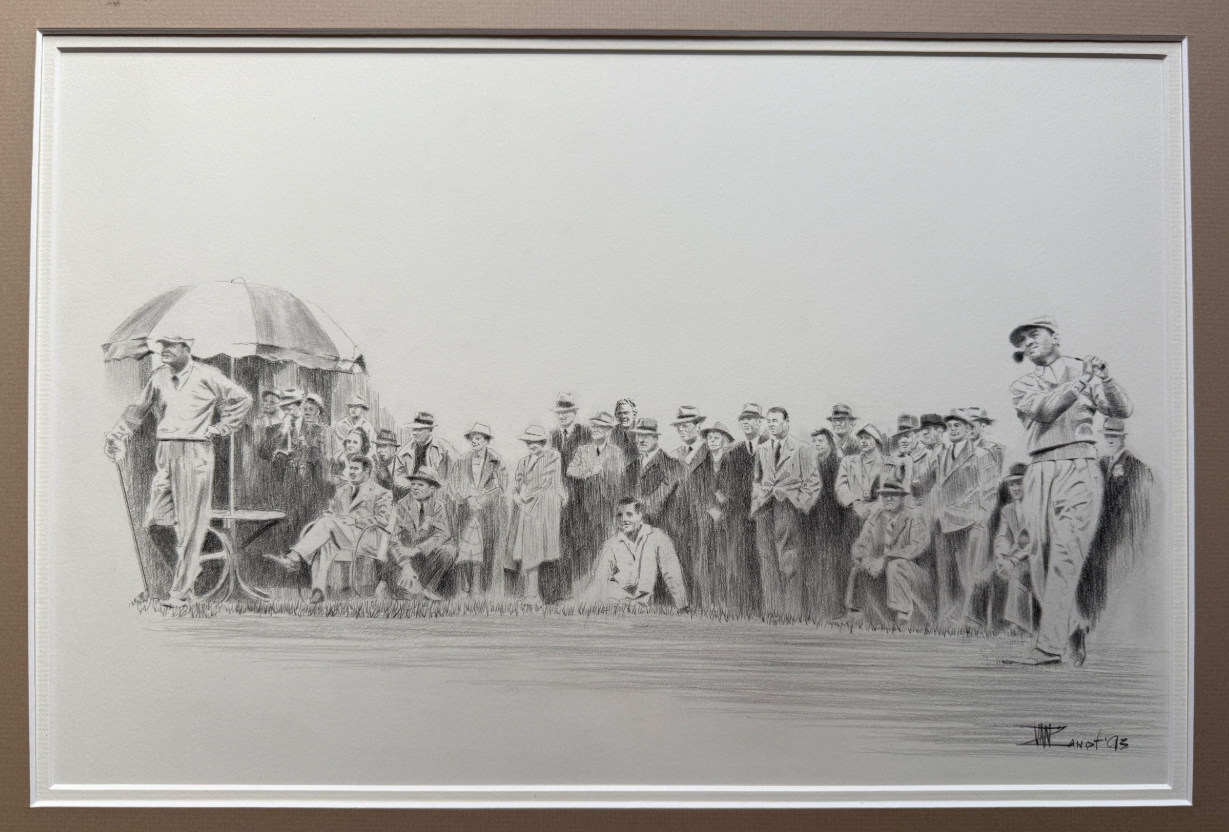
The item is a framed drawing from GHS President George Petro’s collection: “Hogan v Nelson playoff, 1942 Masters,” rendered by William Van Zandt. And what I like about it right away is that it does not try to overwhelm you. It is quiet. Subtle. Almost understated. But the longer you look at it, the more it opens up.
That is usually a very good sign.
This piece is not about a random pairing or a generic old-time golf scene. It captures a playoff between two men whose lives had been linked long before Augusta. Hogan and Nelson were both Texas products, both born in 1912, and both came up through the caddie yard at Glen Garden in Fort Worth. The USGA notes that Nelson met Hogan there as a kid, and the two spent countless hours hitting balls and sharpening their games. As 15-year-olds, they even met in Glen Garden’s caddie championship, with Nelson edging Hogan by a stroke.
So when you look at this drawing, you are not just looking at a Masters scene. You are looking at one chapter in one of golf’s great shared origin stories.
That is part of what gives the artwork its pull.
The 1942 Masters itself carries real historical weight. Byron Nelson beat Ben Hogan by one stroke in an 18-hole playoff to claim his second Masters title, and Masters records still list Nelson’s victories in 1937 and 1942. It also turned out to be the last Masters played until 1946 because of World War II, which gives the moment an even more suspended, almost haunted quality when viewed from this distance.
And Van Zandt understood the kind of moment he was drawing.
What makes this piece work for me is that it is not merely a portrait of Hogan and Nelson. It is a scene. A gathering. A championship memory. The crowd is packed in tightly, dressed in coats and hats, the sort of gallery that instantly places you in another era. Hogan is off to the right in motion, the club high, the body turning through. Nelson stands back near the umbrella. The spectators form almost a human wall between them, which feels appropriate. Even if these two men came from the same soil and the same caddie yard, competition had long since made them separate figures in the public imagination.
That tension lives in the drawing.
It is also helped by the medium. Graphite was the right choice for this subject. A louder treatment might have pushed the piece too far into nostalgia. This one feels restrained. The soft grayscale suits the memory of old tournament photography, and it gives the scene the look of something half-remembered but deeply felt. In that sense, Van Zandt was not simply illustrating an old result. He was translating golf history into mood.
That matters in a collectible.
Not every meaningful golf collectible has to be a contemporaneous artifact. A period press photo, ticket, program, or badge often carries the strongest documentary punch because it was there when the moment happened. But a later piece of art can have a different kind of value when it is done well and when its backstory is right. In this case, the backstory is part of the appeal. In 1993, George Petro saw William Van Zandt at the Baltusrol U.S. Open and asked him to draw this scene for him. That gives the piece its own provenance, its own human chain of custody, and its own reason for existing beyond simple decoration.
It was not mass produced for gift-shop walls. It was requested by someone who understood the history and wanted this moment specifically.
That gives it character.
It also helps that the subject lands so neatly in the present week. With the TOUR in Texas, it is natural to think about Hogan and Nelson anyway. With the Masters starting next week, it is natural to think about Augusta’s long memory. This drawing gives you both at once. It connects Texas golf roots to Augusta pressure. It links youthful rivalry to major-championship consequence. It reminds you that before Hogan became Hogan and Nelson became Nelson, they were just two boys from Texas chasing the game together.
That, to me, is why this piece feels like more than a handsome work of golf art.
It feels like timing.
It feels like friendship, rivalry, geography, and championship history all pressed into one frame. It feels like the kind of collectible that rewards a second look, then a third. And in a week when the game sits between Texas and Augusta, between one big stop and the season’s first major, that feels just about perfect.